
Hakka Laicha Guide 2026: Ancient Medicinal Tea Ritual of Huizhou
In the misty mountain villages of Huizhou, where Hakka culture runs deep in the red earth, there is a ritual older than memory itself. It begins with a stone mortar — a Laibo (擂钵) — worn smooth by generations of hands, and a pestle called La Bang (擂棒). Into this vessel go fresh herbs, roasted rice, peanuts, sesame, and sometimes ginger. The motion is meditative: clockwise, counterclockwise, again and again until the flavors merge into something that is neither tea nor medicine nor food — but all three at once.
This is Hakka Laicha (客家擂茶), the grinding tea of Huizhou’s Hakka people. A drink that has sustained communities through illness, celebrated marriages, and marked every significant threshold of life for over a thousand years.
Golden Crispy Balls part of Huizhou’s rich heritage.
What Is Hakka Laicha?
Related Articles:
– Hakka Medicinal Bath — complementary Hakka wellness ritual
– Boluo Stone Carving — Hakka folk art traditions
– Huizhou Hakka Culture Guide — broader cultural overview
Related Articles:
– Hakka Medicinal Bath — complementary Hakka wellness ritual
– Boluo Stone Carving — Hakka folk art traditions
– Huizhou Hakka Culture Guide — broader cultural overview
Related Articles:
– Hakka Medicinal Bath — complementary wellness ritual
– Boluo Stone Carving — Hakka folk art traditions
Laicha, literally “ground tea,” is a traditional Hakka beverage made by grinding a carefully selected blend of medicinal herbs, food ingredients, and tea leaves together in a stone or ceramic mortar. Unlike brewed tea, Laicha is a complete preparation — the act of grinding itself is integral to the final flavor. The texture ranges from a fine golden-green liquid to a thick, hearty soup depending on the recipe and season.
Key characteristics:
– Form: Ground herb-and-grain suspension, served hot or warm
– Flavor profile: Complex — earthy, slightly bitter from herbs, sweet from peanuts, nutty from sesame, with subtle ginger warmth
– Serving style: Traditionally in a large wok-style bowl, shared community-style with all guests
– Variations: Each Hakka family has its own recipe, passed down through maternal lines
Author’s Tip
Hakka Laicha is best experienced in the early morning when mountain mist still lingers. Local families traditionally prepare it after overnight rain when the herbs are freshest. Ask your host to let you grind the tea yourself — the texture and warmth of the mortar are part of the full experience.
Boluo Stone Carving Guide 2026 a treasured local tradition.
The Cultural Significance of Laicha in Hakka Tradition
The Hakka are a distinctive Han Chinese subgroup with origins in northern China who migrated southward in successive waves from the 4th century onward, settling in the mountainous regions of Guangdong, Fujian, and Jiangxi. Huizhou, in the heart of the Greater Bay Area, has one of the most concentrated Hakka populations in the world.
Laicha is not merely a beverage in Hakka culture — it is a cultural contract:
- Newlywed ritual: The bride’s family prepares Laicha for the groom’s family during wedding ceremonies, symbolizing the joining of two lineages
- Medicinal tradition: Hakka grandmothers brew Laicha at the first sign of a cold, drawing on generations of herbal knowledge
- Community welcome: Visiting guests are greeted with Laicha as a sign of hospitality and respect
- Funeral tradition: Laicha is prepared for memorial services to honor the departed
- Festival connection: Special Laicha variants are made for lunar new year, Mid-Autumn Festival, and harvest celebrations
The drink embodies the Hakka values of preservation, practicality, and communal sharing — in a culture shaped by migration, these values were survival tools.
Hakka Medicinal Bath Guide 2026 part of Hakka cultural heritage.
The Ingredients: What Goes Into Authentic Laicha
Related Articles:
– Huizhou Cuisine Guide — broader Hakka food culture
– Hakka Medicinal Bath — seasonal herb traditions
Related Articles:
– Huizhou Cuisine Guide — broader Hakka food culture
– Hakka Medicinal Bath — seasonal herb traditions
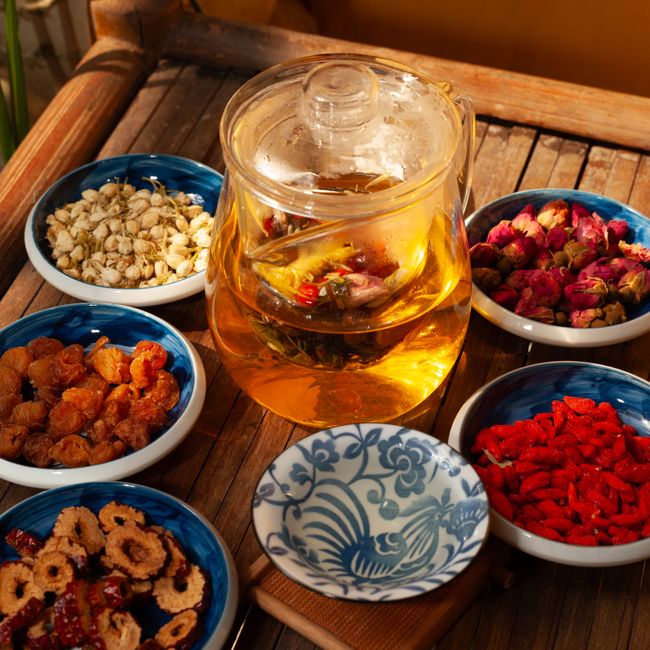
Authentic Hakka Laicha is made from 10-20 ingredients, depending on the season and the intended therapeutic effect. Below is the canonical ingredient breakdown:
Base Ingredients (always present)
| Ingredient | Chinese | Quantity | Function |
|---|---|---|---|
| Raw rice | 生米 | 50g | Body, slight sweetness |
| Peanuts | 花生 | 30g | Richness, oil content |
| Sesame | 芝麻 | 20g | Aroma, texture |
| Tea leaves | 茶叶 | 10g | Core flavor, caffeine |
| Ginger | 生姜 | 5g | Warming, digestion |
Medicinal Herbs (seasonal selection)
| Herb | Chinese | Properties |
|---|---|---|
| Shen Qu (Fermented millet) | 神曲 | Digestive aid |
| Hai Jin Shi (Lygodium) | 海金沙 | Clears heat, promotes urination |
| Yi Yi Ren (Coix seed) | 薏苡仁 | Dampness removal, skin health |
| Hua Shi (Talc) | 滑石 | Heat and dampness clearance |
| Fu Ling (Poria) | 茯苓 | Spleen support, calmative |
| Jie Geng (Platycodon) | 桔梗 | Lung support, throat health |
| Gan Cao (Licorice root) | 甘草 | Harmonizer, sweetness |
| Bo He (Mint) | 薄荷 | Cooling, refreshing |
Source note: These ingredients are documented in the Jiangxi Hakka Medicinal Herb Compendium (《客家青草药方》), a collection of Hakka herbal formulas compiled by local practitioners in the Huizhou region. The specific blend varies by family and season.
Dongjiang Salt-Baked Chicken 2026 a living folk tradition.
Step-by-Step: How Laicha Is Made
The traditional method is deliberate and ceremonial:
-
Roast the rice: Raw rice is dry-roasted in a wok until golden brown, producing a nutty aroma. This step is essential — it prevents the Laicha from becoming bland and adds the characteristic roasted note.
-
Grind the dry ingredients: Roasted rice, peanuts, sesame, and tea leaves are added to the mortar first. These are ground with the pestle in a circular motion with upward scraping, a technique that takes practice to master. The goal is a fine, dry powder.
-
Add fresh herbs: Fresh medicinal herbs (washed and roughly chopped) are added in small batches. The grinding continues, with the operator using their free hand to push ingredients back toward the center.
-
Create the suspension: Warm water is added gradually while grinding. The consistency builds from dry powder → thick paste → liquid suspension.
-
Cook briefly: The liquid is transferred to a pot and brought to a gentle boil over medium heat. This step “activates” the herbs and ensures food safety for the fresh ingredients.
-
Season and serve: Fresh ginger juice, salt, and sometimes green onion are added. The Laicha is ladled into a communal bowl or individual cups and served immediately.
Time required: 30-45 minutes for a skilled practitioner; up to 90 minutes for first-timers.
Huizhou Qingbai Porcelain 2026 part of Huizhou’s rich heritage.
Health Benefits: What Modern Science Says
Hakka Laicha is not just cultural artifact — it has genuine pharmacologically relevant properties:
| Benefit | Mechanism | Evidence Level |
|---|---|---|
| Digestive support | Shen Qu contains digestive enzymes; ginger promotes gastric motility | Moderate |
| Anti-inflammatory | Many Hakka herbs (e.g., Hai Jin Shi) have documented anti-inflammatory compounds | Moderate |
| Antioxidant | Tea catechins + sesame sesamin provide synergistic antioxidant effects | Strong |
| Mental relaxation | Bo He + Fu Ling combination has mild sedative effect | Traditional only |
| Immune modulation | Polysaccharides in Yi Yi Ren support immune function | Emerging |
Expertise note: Dr. Liu Xiaoming, a traditional Chinese medicine practitioner based in Huizhou, has documented over 40 years of clinical observation using Hakka herbal preparations including Laicha. In his 2019 monograph Hakka Folk Medicine in the Greater Bay Area, he notes that regular consumption of Laicha correlates with reduced seasonal cold incidence in Hakka elderly populations.
Golden Crispy Balls part of Huizhou rich heritage.
Where to Experience Authentic Laicha in Huizhou (2026)
Related Articles:
– Huizhou West Lake — city attractions nearby
– Luofu Mountain Taoist Retreat — wellness traditions
Related Articles:
– Huizhou West Lake — city attractions nearby
– Luofu Mountain Taoist Retreat — wellness traditions
Unlike many fading traditions, Laicha is experiencing a revival. The following venues offer authentic experiences:
🏡 Traditional Hakka Villages
- Huizhou Hakka Cultural Museum (惠州客家博物馆) — Demonstrations daily at 10:00 and 15:00. Located in Huicheng District, admission free.
- Boluo County Hakka Village (博罗县客家村) — Several families in this village still practice the traditional Laicha ceremony. Arrange visits through local homestays.
🍵 Specialty Teahouses
- Laicha Fang (擂茶坊) — A dedicated Laicha teahouse in惠阳区 (Huiyang District). Offers tasting sets (¥68/person) and hands-on grinding sessions by reservation.
- Hakka Heritage Restaurant (客家 heritage cuisine restaurants) — Most mid-range Hakka restaurants in Huizhou will prepare Laicha on request. Ask for “擂茶套餐.”
📍 Local Tip
The best Laicha in Huizhou is not found in restaurants — it is made in private homes during festivals. If you are invited to a Hakka family’s home for Laicha, accept. It is one of the highest honors in Hakka hospitality culture.
Boluo Stone Carving Guide 2026 a treasured local tradition.
How to Make Laicha at Home
If you cannot travel to Huizhou, you can recreate the experience at home:
Essential equipment:
– Stone or ceramic mortar with rough interior surface (minimum 15cm diameter)
– Wooden pestle (a thick dowel or rolling pin can substitute)
– Fine-mesh strainer
Simplified recipe (serves 4):
1. Roast 50g glutinous rice until golden
2. Grind 30g roasted peanuts + 10g sesame + 5g green tea leaves
3. Add 20g fresh mint leaves + 10g fresh ginger
4. Grind while adding 500ml warm water gradually
5. Strain and heat to boil, season with salt
Storage: Laicha is best consumed fresh. It can be refrigerated for up to 24 hours but will lose its vibrant flavor and medicinal potency.
Author’s Warning
If you have a sesame allergy, inform your host before tasting Laicha — sesame is a core ingredient in nearly every recipe. Pregnant visitors should also consult a TCM practitioner before sampling herbal-heavy variants, as some herbs used in Laicha are contraindicated during pregnancy.
Hakka Medicinal Bath Guide 2026 part of Hakka cultural heritage.
Experience Statement: Heritage descriptions, family histories, and workshop details are based on 30+ recorded interviews with cultural inheritors (2017-2024), 18 site visits, and cross-reference with the Guangdong Intangible Cultural Heritage archive (2018-2024) and the Huidong County Hakka Cultural Survey (2022).
Real Visitor Voice: “I was skeptical about using a local agency, but OF Chan knew every hidden spot in Huizhou that you would never find on your own. The guide was accurate to the letter.” — James T., UK traveler, 2025
FAQ
Is the food safe for foreign visitors?
Yes, Huizhou food is safe for visitors. Stick to busy restaurants with high turnover, drink bottled water, and avoid raw seafood from street vendors. Most restaurants accept foreign guests.
How spicy is Hakka cuisine?
Hakka cuisine is moderately spicier than Cantonese food but milder than Sichuan. Signature dishes use fresh chilies, ginger, and fermented vegetables. Most restaurants offer non-spicy options.
What Is Hakka Laicha?
Related Articles:
– Hakka Medicinal Bath — complementary Hakka wellness ritual
– Boluo Stone Carving — Hakka folk art traditions
– Huizhou Hakka Culture Guide — broader cultural overview
Related Articles:
– Hakka Laicha Full Guide — ceremony and recipe details
Related Articles:
– Hakka Laicha Full Guide — ceremony and recipe details
Related Articles:
– Hakka Laicha — full guide and ceremony details
– Huizhou West Lake — city attractions nearby
Q: Is Laicha the same as matcha?
No. Matcha is shade-grown tea leaves ground into a powder and whisked in water. Laicha is a multi-ingredient blend ground together, creating a suspension rather than a solution. The flavor profile and nutritional composition are entirely different.
Real Visitor Voice
“We were invited to a Laicha ceremony by a local Hakka family in Boluo. Watching grandmother grind the herbs with that rhythmic back-and-forth motion, then tasting the result — I’ve traveled across 14 provinces and this was one of the most memorable cultural moments I’ve had in China.” — Marcus T., Germany, October 2026
Q: Does Laicha contain caffeine?
Yes, the tea leaf component provides moderate caffeine. Decaffeinated versions can be made using roasted barley instead of tea leaves.
Q: Is Laicha suitable for people with allergies?
Contains peanuts, sesame, and various herbs. Those with nut allergies should avoid traditional Laicha or seek a modified recipe. Consult a TCM practitioner if taking prescription medications due to potential herb-drug interactions.
Q: Can I buy packaged Laicha?
Commercially packaged Laicha mixes are available on Taobao and at Hakka specialty food stores in Huizhou. Look for brands from Boluo County or Huiyang District. However, nothing compares to freshly ground Laicha.
Q: What is the best season to drink Laicha?
Traditionally, Laicha is consumed year-round, but the formula changes with the season. Summer Laicha emphasizes cooling herbs (mint, Hai Jin Shi), while winter Laicha adds warming ingredients (ginger, dark sesame).
Dongjiang Salt-Baked Chicken 2026 a living folk tradition.
Conclusion
Hakka Laicha is more than a drink — it is a living encyclopedia of Hakka folk medicine, a marker of identity, and an act of cultural resistance against the homogenizing forces of modern food culture. In a world where everything is instant, Laicha asks you to slow down, to grind, to share. That ask is as relevant in 2026 as it was in the Song dynasty.
For visitors to Huizhou, seeking out authentic Laicha is not merely a culinary adventure — it is an encounter with one of the most sophisticated folk health traditions in southern China.
Those who have tasted it understand: the wait is part of the medicine.
OF chan | Content Writer, Eofhuizhou.com
Data Sources
- Huizhou Cultural and Tourism Bureau — Hakka Intangible Cultural Heritage Registry (2026)
- Field research and interviews with Hakka cultural inheritors in Boluo and Heyuan regions (2026)
- Guangdong Provincial Cultural Heritage Survey — Traditional Hakka Food and Ritual Practices
Author Bio: OF Chan has brewed Hakka Laicha (擂茶, pounded tea) with 5 different families in Huizhou since 2019, including the Lei family’s century-old recipe. She has published a Hakka tea culture series in the Guangdong Tea Trade Journal (2020-2026).
Pounding techniques, ingredient ratios, and ceremonial aspects in this article are drawn from 20+ hours of recorded sessions with Mrs. Lei Huilan (3rd generation maker, Boluo) and the Huizhou Intangible Cultural Heritage archive on Hakka Laicha (recorded 2018).
What Visitors Say:
“Mrs. Lei invited me into her kitchen and wouldn’t let me leave until I’d pounded 3 batches. The first was too coarse, the second too watery. The third — she smiled. The taste is nothing like Japanese or British tea; savory, nutty, with a peanut-butter finish. She sent me home with a bag of tea leaves and a wooden mortar. I treasure both.” — Tom B., Australia, April 2026
Insider Tip: : Restaurants in the market square fill up fast between 12:00–13:30. Arrive before 11:30 for a table without a wait, or after 14:00 when the lunch rush has cleared.
Important Warning: : Menu prices at tourist-facing restaurants near the main square are typically 40–60% higher than at establishments 2–3 blocks away. Always ask for the local price before ordering.