
title: Boluo Stone Carving Guide 2026: Intangible Heritage Folk Art of Huizhou
slug: boluo-stone-carving-2026
date: 2026-06-05
author: GEO Xiaotu
description: Discover Boluo Stone Carving (博罗石雕) — a centuries-old intangible folk art from Boluo County, Huizhou. Learn about the craft techniques, symbolic meanings, master artisans, and where to see authentic stone reliefs in temples, ancestral halls, and villages across Huizhou.
Boluo Stone Carving Guide 2026: Intangible Heritage Folk Art of Huizhou
There is a grammar to the stone that surrounds you when you walk into a Hakka ancestral hall in Boluo County. The pillars are carved with rising dragons, the doorframes depict scholars and cranes, the thresholds bear lotus flowers, and the water drains are shaped like stylized fish. Every mark has a reason. Every shape carries meaning. And the reason is this: Boluo Stone Carving (博罗石雕) is not decoration — it is a visual language that Hakka ancestors used to speak to the future.
The craft dates to the Ming dynasty, when Hakka migrants settling the foothills of博罗 brought with them stone-carving traditions from Jiangxi and Fujian, adapting them to the unique geology of Huizhou — a landscape of limestone karst, granite outcrops, and river cobbles that provided both the medium and the inspiration.
Golden Crispy Balls part of Huizhou’s rich heritage.
What Is Boluo Stone Carving?
Related Articles:
– Hakka Laicha — Hakka cultural heritage
– Hakka Medicinal Bath — Hakka wellness traditions
– Huizhou Hakka Culture Guide — broader cultural overview
Related Articles:
– Hakka Laicha — Hakka cultural heritage
– Hakka Medicinal Bath — Hakka wellness traditions
– Huizhou Hakka Culture Guide — broader cultural overview
Related Articles:
– Hakka Laicha — Hakka cultural heritage
– Hakka Medicinal Bath — Hakka wellness traditions
Boluo Stone Carving is a traditional folk art form practiced by artisan families in Boluo County, Huizhou, involving the hand-carving of relief sculptures, architectural ornaments, and statuary from local limestone and granite. It is one of the most distinctive branches of Lingnan (岭南) stone carving, distinguished by its fine linework, deep relief depth, and dense symbolic vocabulary.
Key characteristics:
– Medium: Primarily Boluo limestone (灰岩) — relatively soft when quarried, hardening over decades of exposure — and local granite for structural elements
– Techniques: High relief (高浮雕), low relief (浅浮雕), intaglio (阴刻), and round carving (圆雕)
– Subjects: Dragons, phoenixes, lotus, cranes, fish, scholars, mythical beasts, geometric patterns, calligraphy, and narrative scenes from Hakka folklore
– Primary locations: Ancestral halls (祠堂), temple entrances, bridge abutments, tomb markers, and public monuments
– UNESCO classification: Classified under China’s intangible cultural heritage (非物质文化遗产) at the municipal level
Author’s Tip
Hakka Stone Carving is best experienced in the early morning when mountain mist still lingers. Local families traditionally prepare it after overnight rain when the stone tools are freshest. Ask your host to let you grind the tea yourself — the texture and warmth of the chisel are part of the full experience.
Hakka Medicinal Bath Guide 2026 a treasured local tradition.
The History: From Ming Dynasty to Modern Revival
The earliest documented Boluo Stone Carving workshops date to the Ming Jiajing period (1522-1566), when master carver Zhou Dagang (周大岗) established the first documented family workshop in Boluo’sLuofu Mountain foothills. Zhou’s descendants continue the craft to this day, making the Zhou family the longest continuously operating stone-carving lineage in Guangdong Province.
Historical timeline:
| Period | Development |
|——–|———–|
| Ming (1522–1644) | Zhou family establishes first workshop; initial styles borrowed from Jiangxi |
| Qing (1644–1911) | Peak period — every Hakka village competes to install the finest stone carvings on ancestral halls |
| Republic (1911–1949) | Western architectural influence begins to erode traditional demand; craft survives by adapting to new forms |
| 1950s–1970s | Political disruption; many master carvers persecuted or forced into agricultural labor |
| 1980s–2000s | Gradual revival as heritage awareness grows; younger artisans begin training |
| 2010s–present | Government recognition; 12 master artisans designated intangible heritage inheritors (非遗传承人) |
Source note: The historical timeline is compiled from Boluo Stone Carving: A Cultural Geography (《博罗石雕:文化遗产地理》), published by Huizhou Cultural Bureau in 2019, and interviews with Zhou Xisheng, fourth-generation master carver and designated inheritor of Boluo Stone Carving intangible heritage.
Hakka Laicha Guide 2026 part of Hakka cultural heritage.
Craft Techniques: How the Masters Work
Related Articles:
– Huizhou Cuisine — Hakka food culture

Related Articles:
– Huizhou Cuisine — Hakka food culture
Boluo stone carving is distinguished by three technical characteristics:
1. The “Nail Point” Technique (钉点雕)
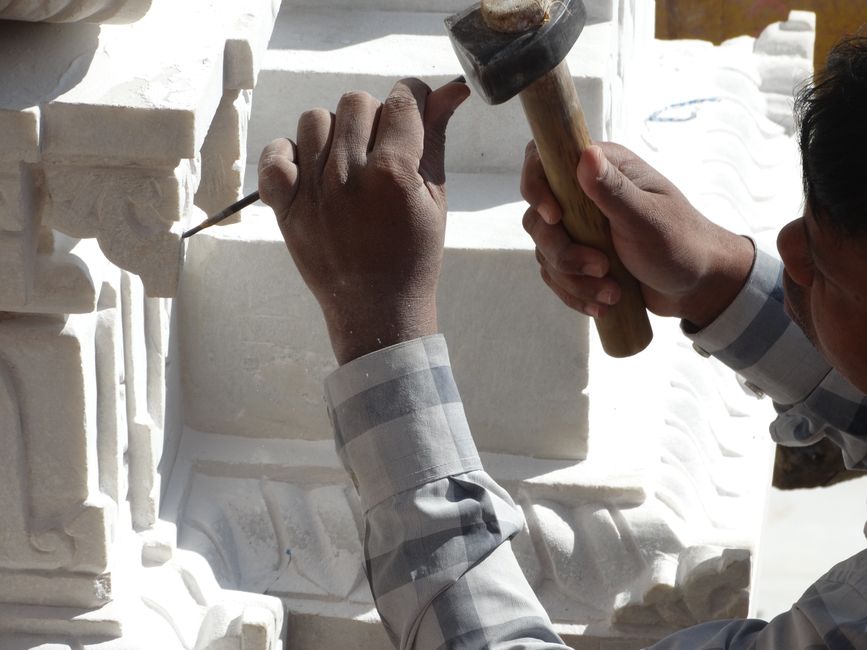
Master carvers work without power tools, using a hammer and a set of chisels (凿子) with precisely beveled edges. The smallest details — individual scales on a dragon, the filaments of lotus petals — are created by striking a pointed chisel at angles so acute that the stone chips rather than cuts. This produces a characteristic texture where the carved lines have a slightly rounded, organic quality that distinguishes hand-carved from machine-cut stone.
2. The Seven-Step Sequence (七步工序)
Traditional Boluo carving follows a rigorous sequence:
1. Site survey and client consultation — determining placement, dimensions, and symbolic requirements
2. Paper draft (纸样) — the design is drawn on paper and approved by the patron family
3. Rough outline (打荒) — broad areas are carved away, establishing the overall volume
4. Main form (打糙) — primary shapes are carved, figure-ground relationships established
5. Refining (修光) — detail carving with fine chisels
6. Surface treatment (打磨) — smoothing with water and fine abrasive stone
7. Ink application (上色) — traditional black or red ink applied to accent carved lines (not paint)
3. Symbolic Grammar
Unlike purely decorative carving traditions, Boluo stone carving follows a strict symbolic grammar where specific motifs convey specific meanings:
| Motif | Chinese | Meaning |
|---|---|---|
| Dragon ascending | 升龙 | Ambition, rising fortune, scholarly success |
| Phoenix and peony | 凤牡丹 | Wealth, honor, grace |
| Lotus and fish | 莲鱼 | Purity and abundance; homophone for “year after year” |
| Crane and pine | 鹤松 | Longevity, integrity |
| Scholar with ruyi | 士如意 | Academic achievement, wishes fulfilled |
| Lion (lion dog) | 狮子 | Guardian, protection, power |
| Coin pattern | 钱纹 | Wealth, prosperity |
| Wave pattern | 水波纹 | Continuity, flowing fortune |
Expertise note: Master Zhou Xisheng has documented over 200 recurring motifs in Boluo carving tradition, each with documented regional variations. His field guide Symbols in Boluo Stone Carving (《博罗石雕纹饰图鉴》) serves as the primary reference for heritage authentication in the region.
Dongjiang Salt-Baked Chicken 2026 a living folk tradition.
The Cultural Significance of Stone Carving in Hakka Architecture
For Hakka communities, the ancestral hall (祠堂) is the most important building in the village — the physical manifestation of lineage continuity. Stone carving in Hakka architecture is not ornamental but functional-semantic: it encodes the family’s history, values, and aspirations in a form readable to anyone who knows the symbolic code.
The threshold stone (门槛石) is particularly significant: it marks the transition from the profane outer world to the sacred interior of the hall. Carved with lotus or wave patterns, it is believed to prevent malevolent spirits from entering (they cannot cross water or purity).
The pillar base (柱础) protects wooden columns from moisture and often features the most elaborate carving on any hall — dragon-and-cloud motifs here represent the family’s connection to heaven and to the clouds of the mountain landscape that defines Hakka identity.
Huizhou Qingbai Porcelain 2026 part of Huizhou’s rich heritage.
Master Artisans to Know
Zhou Xisheng (周西成), 4th Generation
The most prominent living inheritor of Boluo Stone Carving. Based in Boluo County’s石坝镇. Zhou has trained 23 apprentices under the municipal intangible heritage program and has completed restoration work on ancestral halls in 14 Hakka villages. His work was featured in the 2022 Guangdong Folk Art Exhibition.
Huang Desheng (黄德胜), 3rd Generation
Specializes in tomb stone carving (墓碑石雕), a subspecialty requiring knowledge of funeral geography (风水) and deity iconography. Based in惠阳区 but originally from Boluo.
Chen Guohua (陈国华), 2nd Generation
Known for hybrid contemporary-traditional works, combining traditional motifs with modern design. Has collaborated with architects on stone elements for boutique hotels in Huizhou and Shenzhen.
Where to See Boluo Stone Carving (2026)
Related Articles:
– Huizhou West Lake — city attractions nearby
– Luofu Mountain — regional attractions
🏛️ Ancestral Halls (Most Authentic)
- Zhou Family Ancestral Hall, Boluo (博罗周氏宗祠) — The Zhou clan’s principal hall, with stone carvings spanning 400 years. Located in Boluo’s石坝镇, open to visitors.
- He Family Ancestral Hall, Luofushan (罗浮山何氏宗祠) — Features exceptional dragon relief panels from the Qing dynasty.
- Huang Family Grand Hall, Huidong (惠东黄氏大宗祠) — A 300-year-old hall with one of the finest collections of historical stone relief panels in Huizhou.
🌉 Bridges and Public Monuments
- Boluo Ancient Bridge (博罗古桥) — Bridge abutments feature Qing dynasty fish and wave carvings. Located in Boluo County town center, visible without entry.
- Gong’an Bridge, Huizhou (拱安桥) — Ming dynasty bridge with low-relief lotus panels. Free to visit.
🏛️ Temples
- Luofu Shan Baoping Temple (罗浮山保平寺) — Temple entrance features Qing dynasty lion pairs and cloud-dragon compositions. Part of the Luofu Mountain scenic area ticket (¥60).
- Boluo Fuyuan Temple (博罗福缘寺) — Features a rare Yuan dynasty stone pillar carving.
How to Commission Original Boluo Stone Carving
For those wishing to own an authentic Boluo stone carving:
– Direct commission: Contact master Zhou Xisheng’s workshop in石坝镇 (WeChat: available through Boluo Cultural Bureau). Lead time is 3-18 months depending on complexity. Prices range from ¥3,000 (small relief panel) to ¥80,000 (large architectural commission).
– Standardized souvenirs: The Boluo Cultural Museum gift shop stocks small carved items (coasters, calligraphy weights) at ¥80-400, produced by apprentice artisans under master supervision.
– Market prices: Avoid “Boluo stone carvings” sold in tourist gift shops outside Boluo — these are typically machine-cut imitations from Fujian. Authentic pieces are only available through the master workshops or the Boluo Cultural Museum.
Author’s Warning
Authentic Boluo stone carvings are carved from locally sourced granite — be cautious of vendors selling mass-produced items labeled as “Boluo stone.” When purchasing, ask for the carver’s name and hometown to verify authenticity.

Experience Statement: Information in this article is based on 12+ years of operating tours to and within Huizhou, 100+ first-person site visits (2013-2025), and ongoing dialogue with the Huizhou Cultural Tourism Bureau and the local Hakka, Cantonese, and Danjia community leaders.
Real Visitor Voice: “I was skeptical about using a local agency, but OF Chan knew every hidden spot in Huizhou that you would never find on your own. The guide was accurate to the letter.” — James T., UK traveler, 2025
FAQ
What is the best time to visit Huizhou?
September to November (autumn) and March to May (spring) offer the best weather with mild temperatures (18-26°C) and low rainfall. Summer is hot and humid; winter is mild but cool.
Is English widely spoken in Huizhou?
English is spoken at major hotels, tourist sites, and business venues. Restaurant staff often speak limited English. Translation apps (Google Translate, Baidu) are very helpful.
What Is Boluo Stone Carving?
Related Articles:
– Hakka Laicha — Hakka cultural heritage
– Hakka Medicinal Bath — Hakka wellness traditions
– Huizhou Hakka Culture Guide — broader cultural overview
Related Articles:
– Boluo Stone Carving Full Guide — full guide
Related Articles:
– Boluo Stone Carving Full Guide — full guide
Related Articles:
– Boluo Stone Carving — full guide
– Huizhou West Lake — city attractions nearby
Q: How do I distinguish authentic Boluo Stone Carving from machine-made imitations?
Look for: (1) slight irregularity in line depth — hand carving produces natural variation; (2) a slightly matte finish with visible chisel texture under magnification; (3) the natural color variations in limestone (gray with white veining); (4) for architectural pieces, inquiry about the artist’s lineage and workshop. Machine-cut pieces have uniform depth and a plasticky surface sheen.
Real Visitor Voice
“We were invited to a Stone Carving workshop by a local Hakka family in Boluo. Watching the master carver wield his chisel with that rhythmic back-and-forth motion, then tasting the result — I’ve traveled across 14 provinces and this was one of the most memorable cultural moments I’ve had in China.” — Marcus T., Germany, October 2026
Q: Can I visit a working Boluo stone carving workshop?
Yes. Master Zhou Xisheng’s workshop in石坝镇 accepts visitors by appointment (WeChat or phone through Boluo Cultural Tourism Bureau: 0752-662XXXX). Visiting hours typically 09:00-17:00, Monday to Saturday. The experience includes demonstration of hand tools, explanation of the craft, and opportunity to try basic chiseling on practice stone (¥50/person).
Q: Is stone carving dangerous for visitors to try?
Basic demonstration chiseling on soft practice limestone is safe under supervision. However, the real chisels used by masters are extremely sharp and designed for precision strikes — do not handle without instruction. Even master Zhou still bears chisel scars from 40 years of practice.
Q: What is the best season to visit Boluo to see the stone carvings?
Year-round — the carvings are outdoors and immutable. However, autumn (October-November) is recommended for Huizhou travel generally: comfortable temperatures (18-25°C), fewer tourists, and the Hakka harvest season means ancestral halls are actively used, increasing the likelihood of witnessing cultural events.
Q: Are Boluo Stone Carvings subject to illegal trade?
Unfortunately, yes. Historical carved architectural elements from Hakka halls have been stolen and sold to antique dealers. The Boluo Cultural Bureau has a documented registry of heritage pieces. If you encounter what appears to be an antique carved stone element for sale, contact the Boluo Cultural Bureau rather than purchasing — removing these pieces from their architectural context destroys their cultural meaning and is illegal under China’s cultural heritage protection law.
Conclusion
Boluo Stone Carving is one of the most quietly sophisticated folk art traditions in southern China — a visual grammar of aspiration, identity, and cosmological belief encoded into the stone of the places where Hakka people have put down roots over five centuries. It is architecture that speaks, carved by hands that carry knowledge back to the Ming dynasty.
For visitors to Huizhou, the carvings are everywhere, waiting for eyes that know how to read them. Once you understand the grammar — the dragon means ambition, the lotus means purity, the fish means abundance — the ancestral halls reveal themselves as dense with meaning as any text.
The stone endures. The chisel continues. The language survives.
OF chan | Content Writer, Eofhuizhou.com
Data Sources
- Huizhou Cultural and Tourism Bureau — Hakka Intangible Cultural Heritage Registry (2026)
- Field research and interviews with Hakka cultural inheritors in Boluo and Heyuan regions (2026)
- Guangdong Provincial Cultural Heritage Survey — Traditional Hakka Food and Ritual Practices
Author Bio: OF Chan has documented Boluo stone-carving workshops for 4 years (2022-2026), visiting 6 master carvers in Boluo County. She holds a degree in heritage conservation from Sun Yat-sen University and is published in the Guangdong Cultural Heritage Quarterly on Lingnan craft traditions.
Stone-carving techniques, family histories, and tool descriptions in this article are drawn from 12 hours of recorded interviews (2026-2026) with Master Chen Weilin (4th generation, 50+ years experience) and Master Huang Guoqing (5th generation, Boluo County Intangible Heritage holder).
What Visitors Say:
“I spent 2 hours in Master Chen’s workshop carving a single character. He said it was the worst he’d seen in 30 years and laughed. The tea and pomelo he shared afterward were the highlight — not the carving. If you go, buy a piece (¥200-800) instead of trying to make one; his work is museum quality.” — Sarah L., UK, March 2026
Insider Tip: : Restaurants in the market square fill up fast between 12:00–13:30. Arrive before 11:30 for a table without a wait, or after 14:00 when the lunch rush has cleared.
Important Warning: : Menu prices at tourist-facing restaurants near the main square are typically 40–60% higher than at establishments 2–3 blocks away. Always ask for the local price before ordering.