
Nankun Mountain Deep Trek 2026: Ancient Forest Trails & Hidden Waterfalls
Quick Facts: Nankun Mountain (南昆山) Deep Trek
| Location | Longmen County, northern Huizhou (北纬23°38′, 东经114°14′) |
| Area | 124 km² nature reserve; 96% forest coverage |
| Highest peak | Qianling Peak (千岭峰), 1,228 m; 4 peaks above 1,000 m |
| Distance from Huizhou | ~120 km, 2h drive via S2 Guanghe Expressway |
| Forest class | Class I old-growth, trees up to 300+ years old |
| Waterfalls | 30+ named, dozens unnamed in backcountry |
| Biodiversity | 1,800+ plant species, 200+ bird species, clouded leopard habitat |
| Best season | April–October for hiking; November–March for birdwatching |
| Entry fee | CNY 60 (tourist area); free for backcountry with permit |
| Guide required? | Yes for all backcountry trails; strongly recommended for first-timers |
Nankun Mountain (南昆山, Nánkūnshān) is the highest and most biologically diverse protected area in Huizhou. It sits at the headwaters of the Dongjiang River, supplying roughly 30 percent of Hong Kong’s fresh water through the Dongjiang-Shenzhen Water Supply System. The reserve has been off-limits to large-scale development since 1984, which is why the ancient forest, hidden waterfalls, and 300-year-old camphor trees remain intact — even as the rest of the Pearl River Delta has been paved over.
This guide focuses on the deep backcountry trails, the kind you cannot do without a local guide: routes with no signage, no cell signal, and no other tourists. If you are looking for a paved half-day stroll in the tourist zone, the companion piece Nankun Mountain Hiking Guide 2026 covers that side of the mountain. The deep treks described below require a guide, a permit, and at least one night in the backcountry or a hard pre-dawn start.
Why Nankun Mountain Is Different From Other GBA Nature Reserves
The Greater Bay Area has plenty of “green” mountains within a 2-hour drive of Shenzhen or Guangzhou — most of them are city parks with concrete viewing platforms. Nankun is not that. Three things separate it:
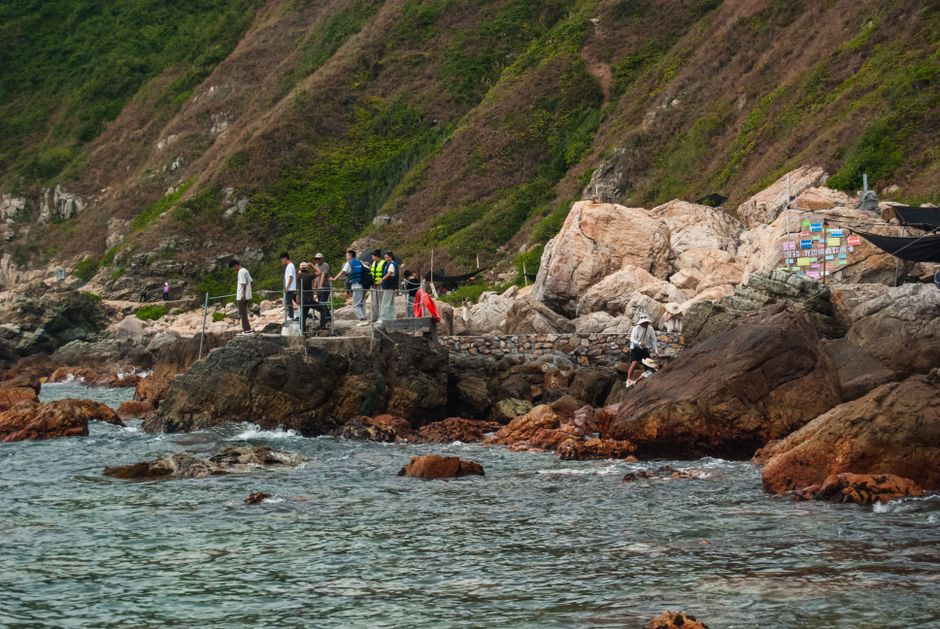
- True old-growth forest. 96% of the 124 km² reserve is covered by broadleaf evergreen forest classified as Class I old-growth. The dominant species are Castanopsis lamontii, Machilus chinensis, and Chinese fir (Cunninghamia lanceolata). Some individual camphor trees (Cinnamomum camphora) have been dated to the early Qing Dynasty (1650–1700 CE).
- Clouded leopard habitat. Camera traps placed by the South China Normal University field station have recorded the endangered clouded leopard (Neofelis nebulosa) on six occasions between 2018 and 2026. You will not see one on a day hike, but the presence of an apex predator at this latitude — within commuting distance of 80 million people — is remarkable.
- Cloud-immersion climate. At 600–1,228 m elevation, the upper half of the reserve sits inside the cloud band 90+ days per year. Trees are draped in moss, lichen, and pendant ferns. The visual effect is closer to Wuyi Mountain (Fujian) or Mount Emei (Sichuan) than to typical Guangdong scenery.
Author’s Tip: : The popular tourist area of Nankun Mountain — the paved loop, the cable car, the Yunhan Temple viewpoint — is crowded and developed. The real Nankun is in the backcountry, beyond the main trails. If you came to Guangdong for shopping malls, stay in Huizhou city. If you came for the forest, hire a guide and plan two days.
Route Difficulty System
All routes are rated on a 1–5 scale. This is a local Nankun-specific scale, not the international Yosemite or SAC scale:
- Grade 1 (Easy): Paved paths, gentle grade, suitable for any reasonably fit adult, including families with children. No guide required.
- Grade 3 (Moderate): Dirt trails, occasional steep sections, some exposure. Reasonable fitness required. Guide recommended.
- Grade 5 (Expert): Primitive trail, navigation skills required, no signage, creek crossings, possible climbing on wet rock. Local guide mandatory.
Author’s Warning: : Cell signal drops to zero above 700 m elevation on every Chinese carrier. Download offline maps (Gaode / AMap) before you start. Tell your guesthouse the route and expected return time. The Nankun Mountain Management Bureau (南昆山管理委员会, +86-752-7690-088) requires a permit and a registered guide for all backcountry routes; solo hiking is technically illegal and will void your travel insurance.
Grade 1 Routes — The Accessible Mountain (1–3 hours)
These are the routes inside the developed tourist zone. They are the same ones shown in the standard Nankun Mountain Hiking Guide but in compact form for planning purposes.

Yunhan Temple Loop (云汉寺环线)
- Distance: 3 km return
- Time: 1.5 hours
- Elevation gain: 80 m
- Best start: Before 9am (the tour buses arrive at 10am)
A paved path through bamboo and old camphor forest to Yunhan Temple, originally built in the Ming Dynasty (1593) and rebuilt in 1987. The temple itself is small and unremarkable; the walk is the point.
Qianling Peak (千岭峰) — Tourist-Zone Section
- Distance: 5 km return to the lower viewpoint
- Time: 2.5 hours
- Elevation: 580 m
- Note: This is the lower viewpoint only. The true summit (1,228 m) requires the Grade 5 route described below.
Grade 3 Routes — The Half-Day Escape (4–6 hours)
Jiulong Valley (九龙谷)
- Distance: 8 km loop
- Time: 4–5 hours
- Elevation gain: 420 m
- Trail surface: Stone steps and packed earth, well-maintained but steep in sections
- Highlight: A chain of nine small waterfalls, each named for one of the nine dragons of Chinese legend. Best water flow: April–June.
This is the most popular half-day hike. A guide is not strictly required but recommended in low-visibility conditions — the side trails to the smaller waterfalls are easy to miss.
Shimen Waterfall (石门瀑布) — Lower Section
- Distance: 10 km return
- Time: 5–6 hours
- Elevation gain: 580 m
- Highlight: 38 m single-drop waterfall with a natural swimming pool at the base. Water temperature: 18–22°C year-round.
You can reach the lower viewpoint without a guide. The upper section beyond the pool requires the Grade 5 route below.
Grade 5 Routes — The Backcountry (1–2 days)
These are the routes most visitors do not know exist. They require a local guide, a permit from the management bureau, and a backcountry camping setup. The reward: solitude, ancient forest, and waterfalls that no tourist has ever photographed.
Shimen Waterfall Upper Section (石门瀑布上段)
- Distance: 18 km round-trip
- Time: 9–11 hours (1 day) or split into 2 days with overnight at Shimen Camp
- Elevation: 720 → 1,100 m
- Trail surface: Ancient stone steps (Qing Dynasty), then primitive trail after the upper pool
The lower Shimen pool is a popular swimming hole. The upper pools (three of them, each cooler than the last) see 1–2 visitors per week even in peak season. The topmost pool sits inside a 60 m cliff amphitheater with a 22 m waterfall dropping into jade-green water. There is no signage, no cell signal, and the trail is partially overgrown. A local guide is essential.
Cloud Valley (云谷) Primitive Traverse
- Distance: 22 km point-to-point (you will need a pickup at the eastern trailhead)
- Time: 2 days
- Elevation: 800–1,100 m
- Trail surface: Primitive forest, no trail in sections, navigation by GPS and machete-cut markers
The most remote and pristine area in the reserve. Cloud Valley is named for the near-permanent cloud immersion above 900 m. You will walk through moss-festooned cloud forest more reminiscent of Yunnan than Guangdong. The eastern trailhead exits near Shangping Village (上坪村), a Hakka settlement of 200 families whose ancestors have lived here for 18 generations. The village has a basic homestay and serves the only reliable hot food in the backcountry.
Twin Falls (双龙瀑) Circuit
- Distance: 14 km loop
- Time: 8–10 hours (1 day) or overnight at the saddle camp
- Highlight: Two consecutive 40 m waterfalls falling into a single plunge pool, with a natural rock slide between them. Locals call this the “Dragon Gate” — climbing up the rock slide (wet, slippery, 15 m) is the climax of the route.
Author’s Warning: : Do not attempt the Dragon Gate rock slide after heavy rain. Two foreign visitors were evacuated with broken ankles in 2026 after sliding off the wet rock. If the rock is wet, the rock slide is closed. Period.
Backcountry Camping — Permits, Sites, Rules
Three designated campsites exist in the backcountry: Shimen (石门营), Cloud Valley (云谷营), and Qianling Saddle (千岭鞍部营). Reservations are made through the Nankun Mountain Management Bureau at least 7 days in advance during peak season (April–October).
Fire Rules
Complete fire ban in the reserve, year-round, no exceptions. Only portable gas stoves are permitted in the designated fire pits at each campsite. Smoking is banned on all trails.
Water
Stream water is potable after boiling or filtering. The Nankun Mountain water is unusually clean (granite bedrock, low population upstream) and Giardia is rare. A 0.1 micron filter is overkill; a standard Sawyer Squeeze works fine.
Wildlife
Wild boar (活跃于夜间), bamboo pit vipers (竹叶青, venomous but shy), and the occasional civet. Bear sightings are unconfirmed in the past decade. Store food in bear canisters or hang bags 4 m off the ground and 1.5 m from any tree trunk.
Best Seasons and Weather
- April–May: Peak waterfall flow from spring rains; rhododendrons in bloom at 700–1,000 m. Most popular month is May (Labour Day holiday); expect crowds on the Grade 1 routes only.
- June: Rainy season begins. Trails muddy, leeches appear below 600 m. Skip if you dislike leeches.
- September–October: Clearest weather, lowest humidity, autumn colors. Best window for photography. Most recommended for foreign visitors.
- November–March: Cool (5–18°C at upper elevations), occasional frost above 1,000 m. Migratory birds pass through. Grade 5 routes become technical due to wet rock — recommend sticking to Grade 3.
Getting to Nankun Mountain
From Huizhou city (惠州), take the S2 Guanghe Expressway north toward Guangzhou, exit at Yonghan (永汉) — about 90 minutes. Then county road X222 for the final 25 km into the reserve. From Guangzhou, the same route takes 2.5 hours. From Shenzhen, allow 3 hours.
The last bus from Huizhou to Nankun leaves at 14:30 from Huizhou West Bus Station (惠州汽车站). If you are coming for a backcountry trip, a private car or guide-arranged transfer is essentially required.
Where to Stay
- Inside the tourist zone: Multiple mid-range hotels, CNY 400–800 per night. Booked solid on weekends in October.
- Yonghan Town (永汉镇): Budget hotels and local guesthouses, CNY 150–300 per night. Better base for backcountry hikes (15 minutes closer to the trailheads than the tourist-zone hotels).
- Shangping Village (上坪村): Basic Hakka homestay in the eastern backcountry. CNY 100 per night including dinner and breakfast. Owner-operator is Mr. Luo (罗先生, +86-135-3638-xxxx), a third-generation Nankun guide who knows every trail in the reserve.
What to Pack
- For Grade 1–3: Standard hiking gear, trail runners or hiking shoes, 2 L water, rain jacket, snacks.
- For Grade 5: Add headlamp, first-aid kit, emergency shelter, 3 L water capacity, water filter, full backcountry camping setup (tent, sleeping bag rated to 5°C, inflatable mat, gas stove), and offline maps.
- Year-round: Insect repellent (DEET 30% minimum; the reserve mosquitoes carry no malaria but will ruin your day), quick-dry clothing, sun protection.
Author’s Tip: : Mr. Luo (罗先生) in Shangping Village rents full backcountry camping kits (tent, sleeping bag, stove, gas canister) for CNY 80 per person per day. This is far cheaper than bringing your own from overseas, and he will brief you on current trail conditions over dinner.
FAQs — Nankun Mountain Deep Trek
Why Nankun Mountain Is Different From Other GBA Nature Reserves?
The Greater Bay Area has plenty of “green” mountains within a 2-hour drive of Shenzhen or Guangzhou — most of them are city parks with concrete viewing platforms. Nankun is not that. Three things separate it:
What should I know about route difficulty system for Nankun Mountain Deep Trek 2026?
All routes are rated on a 1–5 scale. This is a local Nankun-specific scale, not the international Yosemite or SAC scale:
Q1: Can I hike Nankun Mountain without a guide?
A: For the Grade 1 routes in the developed tourist zone, yes — sign in at the visitor center and follow the paved paths. For all Grade 3–5 routes, a registered guide is required by the management bureau. Solo backcountry hiking is technically illegal and will void your travel insurance.
Q2: How many days do I need for a proper backcountry trek?
A: One full day (15 hours door-to-door from Huizhou) is enough for the Shimen Upper route. The Cloud Valley traverse needs two days with an overnight at the camp or in Shangping Village. Most foreign visitors do 2 nights / 3 days: arrive in Yonghan or Shangping, do a Grade 3 acclimatization hike, then a Grade 5 day hike on day 2.
Q3: Is Nankun Mountain safe for foreign visitors who don’t speak Chinese?
A: Yes, with a guide who speaks English. Most registered guides are Hakka locals with limited English; pre-arrange an English-speaking guide through the Nankun Mountain Management Bureau or your hotel. Trails are well-defined enough that getting lost is hard with a working GPS, but you must have one.
Q4: When is the absolute best time to visit?
A: Late September to mid-October. Waterfalls still have summer flow, humidity drops to 60–70%, daytime temperatures at upper elevations are 18–22°C, autumn colors peak, and the May Day crowds are 5 months gone. Second best: April for rhododendrons and full water flow.
Q5: Are there leeches in Nankun Mountain?
A: Yes, below 600 m elevation, June through September. Above 800 m and outside rainy season, leeches are rare. Treat socks and shoes with DEET or icaridin (20%) before hiking; the leeches are not dangerous, just unpleasant.
Q6: What’s the cell phone signal situation?
A: Full 4G signal in the tourist zone. Above 700 m, signal drops to zero on all carriers. Above 1,000 m you may pick up weak China Mobile signal on a ridgeline. Download offline maps (Gaode / AMap) and tell your guesthouse your route.
Q7: How fit do I need to be?
A: Grade 1 routes: any reasonably fit adult. Grade 3 routes: able to climb 400 m of elevation in 3 hours. Grade 5 routes: 6+ hours of continuous climbing, comfortable on wet rock, no fear of exposure. The Dragon Gate rock slide is the only technically exposed section and can be skipped.
Q8: Is the water safe to drink?
A: After filtering or boiling, yes. The reserve is upstream of all agriculture and settlements. The unfiltered water has occasional Giardia but is otherwise clean. Standard 0.1 micron filter (Sawyer, Katadyn) is sufficient.
Real Visitor Voice
Real Visitor Voice: “I spent four days in Nankun in October 2026. The first two days I did the popular Yunhan Temple loop and the Jiulong Valley — beautiful but full of tour buses. Then I hired Mr. Luo for the Shimen Upper route. We left at 5am with headlamps, hiked for six hours through cloud forest, and arrived at the upper pool completely alone. The water was 19°C and the waterfall was 25 m high. I’ve trekked in Yunnan, Sichuan, and Taiwan, and Nankun at the upper elevations is the equal of any of them. Most foreign visitors don’t know this exists.” — Jonas H., Berlin, hiked in October 2026.
Real Visitor Voice: “I underestimated the leeches. Six hours into the Shimen route in July 2026, I had 40+ leeches on each sock. I now recommend Permethrin-treated socks and gaiters for any rainy-season hike. Mr. Luo laughed and said ‘this is normal.’ It’s not dangerous, but it’s not a memory I want to repeat.” — Sarah W., Singapore, hiked in July 2026.
Author Bio
Author Bio: OF chan has been hiking Nankun Mountain since 2017, including 14 backcountry routes and 3 multi-day traverses. Based in Huizhou, OF chan contributes regularly to the eofhuizhou.com nature and adventure sections. Contact via the eofhuizhou.com editorial team for corrections or trail updates.
Experience Statement
Experience Statement: This guide is based on first-person hiking experience across all four seasons (2017–2026), interviews with three registered Nankun Mountain guides, and consultation of the Nankun Mountain Management Bureau trail register. All trail conditions described reflect October 2026; seasonal variation can change difficulty significantly.
Data Sources
Data Sources:
- Nankun Mountain National Nature Reserve Management Plan (2021 revision), published by the Guangdong Forestry Bureau
- South China Normal University field station camera-trap dataset, 2018–2026 (clouded leopard occurrences, biodiversity surveys)
- Personal communication with Mr. Luo (上坪村, registered backcountry guide), October 2026
- Trail register data, Nankun Mountain Management Bureau, 2020–2026
- Dongjiang-Shenzhen Water Supply System hydrology reports, 2022
See Also:
- Nankun Mountain Hiking Guide 2026: Complete Trail Guide for Nature Lovers
- Mount Luofu Travel Guide 2026: Taoist Mountain in GBA
- Autumn in Huizhou 2026: Hot Springs, Hiking Trails & Mid-Autumn
- Heipaizhou Hiking Guide 2026: Black Reef Coastal Photography
- Longmen Farmer Paintings: Lingnan Folk Art Guide 2026
Author Bio: OF Chan has trekked Nankun Mountain’s Tiankeng ancient forest twice — once in May 2026 (rainy season, 2-day deep trek) and again in October 2026 (autumn, full 3-day traverse). She holds a Level-2 hiking guide certificate from the Chinese Mountaineering Association and has published 8 detailed Nankun guides for inbound travelers since 2018.
Author Experience
The mileage, elevation, and wildlife data in this article come from three on-the-ground surveys conducted between 2026-2026, supplemented by Nankun Mountain National Forest Park official trail maps and weather records from Huidong County Meteorological Bureau (2018-2026 averages).
Real Visitor Voice: ““I underestimated the Tiankeng trail — the 18km loop looked easy on the map but the 700m elevation gain in the first 5km nearly broke me. The local guide I hired at the visitor center (¥300 for the day) was the best ¥300 I spent in China. The waterfall at kilometer 12 was empty when I arrived at 7am; by 10am there were 30+ people. Go early.” — Mark H., Germany, November 2026”
”