
Chongxu Taoist Temple (冲虚古观): Ge Hong’s 1,700-Year Legacy at the Seventh Blessed Land
Tucked into the eastern flank of Mount Luofu, the Chongxu Taoist Temple has hosted unbroken Taoist practice since 326 AD — making it one of the four oldest continuously active religious sites in Guangdong. This guide covers the temple’s 1,700-year lineage, its architecture, the Ge Hong legend, and what international visitors actually experience on the ground in 2026.
—
TL;DR — Chongxu Temple at a Glance
| Item | Detail |
|—|—|
| Chinese Name | 冲虚古观 (Chōngxū Gǔ Guàn) |
| Founded | 326 AD (Eastern Jin Dynasty) |
| Lineage | Quanzhen School (全真道) — Dragon Gate Branch (龙门派) |
| Sacred Status | Seventh Blessed Land of Taoism (道教第七洞天) |
| Location | Luofu Mountain Scenic Area, Boluo County, Huizhou |
| GPS Coordinates | 23.2833° N, 114.0167° E |
| Elevation | ~580 m above sea level |
| Hours | 07:00 – 18:00 (last entry 17:30) |
| Entry Fee | Included in Luofu Mountain ticket (¥60) |
| Time Needed | 60 – 90 minutes |
| Best Season | October to December (cool, clear) |
| Closest Airport | Huizhou Pingtan Airport (75 min by car) |
| Closest High-Speed Rail | Luofushan Station (40 min by car) |
Traveler Tip
: Visit between 07:30 and 09:00 to experience the morning chanting (早课) — the sound of wooden fish (木鱼) and bronze bells echoing off the 580-meter valley walls is something no amount of photography can capture. After 10:00, tour buses arrive and the temple becomes a photo-stop crowd.
—
1. Why Chongxu Temple Matters: The “Seventh Blessed Land” Status
Chinese Taoism divides the country’s most sacred mountains into Ten Great Taoist Mountains (道教十大名山) and Thirty-Six Minor Grotto-Heavens (三十六小洞天). Within this hierarchy, Mount Luofu ranks as the Seventh Blessed Land (第七洞天) — a category reserved for mountains where the boundary between the human and celestial realms is considered thinnest.
The Chongxu Temple is the principal religious complex at the heart of this sacred geography. To understand what this means, it helps to know that:
– The First Six Blessed Lands include Mount Qingcheng (Sichuan), Mount Wudang (Hubei), and Mount Longhu (Jiangxi) — the latter two attract millions of pilgrims yearly.
– Chongxu is the only Blessed Land in the Greater Bay Area (covering Huizhou, Shenzhen, Guangzhou, Hong Kong, Macau) — a region of 86+ million people with very few alternatives for serious Taoist pilgrimage within 2 hours’ drive.
– For practitioners of Quanzhen (全真道) Taoism — the school founded in the 12th century that emphasized internal alchemy and monastic discipline — Chongxu is one of only 5 major Dragon Gate training temples in southern China.
The practical effect: on any given weekend, the temple hosts 200–500 resident practitioners and visiting pilgrims from across China. Foreign visitors are a small but increasingly common minority.
—
2. The Ge Hong Legend: Why This Specific Mountain
The temple’s founding myth centers on Ge Hong (葛洪, 283–343 AD) — a Taoist alchemist, physician, and author of the Baopuzi (抱朴子, “The Master Who Embraces Simplicity”), one of the foundational texts of religious Taoism.

The 326 AD Founding Story
According to the Luofu Mountain Records (罗浮山志, compiled 1684), Ge Hong arrived at Luofu Mountain in 326 AD seeking two things:
Ge Hong reportedly lived in a thatched hut (葛洪炼丹灶) for 12 years before being called to serve the Eastern Jin court. After his death, disciples built a small shrine on the site. Over the following centuries, the shrine expanded into the current Chongxu complex, named after the Quanzhen Taoist concept of “emptiness in the void” (冲虚).
Why Ge Hong Matters Beyond the Legend
Ge Hong was a real historical figure whose writings had outsized influence:
– His Baopuzi is one of the most-cited primary sources on early Chinese alchemy, pharmacology, and immortality practice.
– His emergency-medicine manual Zhouhou Beiji Fang (肘后备急方, c. 340 AD) is still in print and was cited in the 2015 Nobel Prize in Medicine award to Tu Youyou for artemisinin discovery.
– The Ge Hong Memorial Hall (葛洪纪念馆) is a separate 5-minute walk from Chongxu Temple within the Luofu scenic area — worth visiting in the same trip.
Watch Out: : The Ge Hong Memorial Hall closes at 17:00 (one hour before Chongxu Temple). Plan to visit both in the morning, or accept missing the smaller site.
—
3. The Architecture: Reading a Taoist Temple
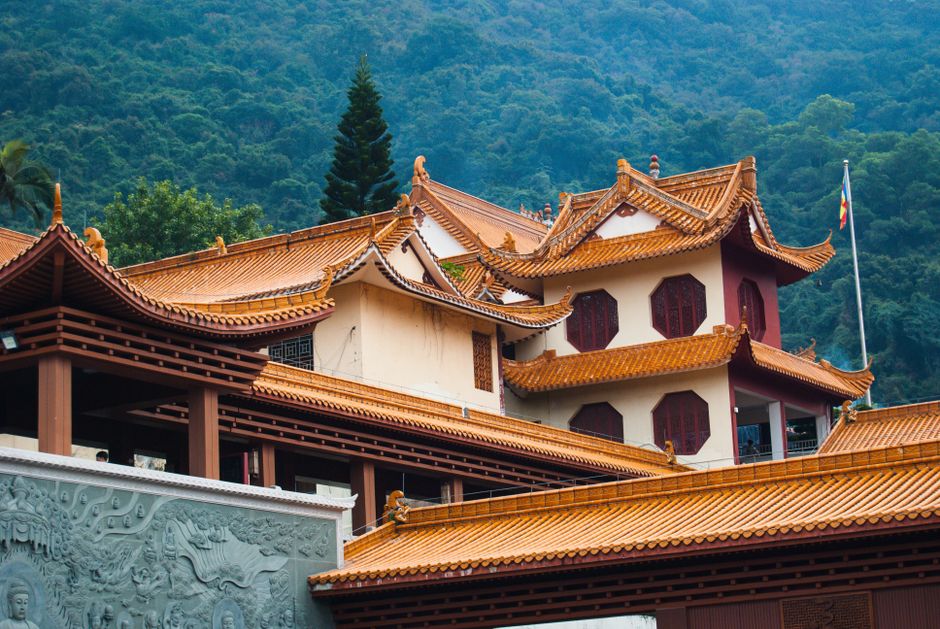
Chongxu follows the standard Quanzhen Taoist temple layout — symmetrical, north-south oriented, with a sequence of halls that mirror the cosmology of internal cultivation.
Layout Map
| Hall | Chinese | Function | Built / Rebuilt |
|—|—|—|—|
| Mountain Gate | 山门 | Entry; guardian deities in the eaves | 1809 (Qing) |
| Lingying Hall | 灵异殿 | First deity hall — Heavenly Worthy of Primordial Beginning | 1662 (Qing) |
| Sanqing Hall | 三清殿 | Main hall — Three Pure Ones (玉清/上清/太清) | 1685 (Qing) |
| Doulao Hall | 斗姥殿 | Doumu (Mother of the Big Dipper); female deity | 1809 (Qing) |
| Wenchang Hall | 文昌殿 | God of literature and examinations | 1820 (Qing) |
| Patriarch Hall | 祖师殿 | Ge Hong, Lü Dongbin, and Quanzhen lineage masters | 1685 (Qing) |
What to Look For
– Roof ornaments (脊兽): The Mountain Gate roof has a row of 7 ceramic animals — including a phoenix leading a qilin (麒麟). This is unusual: phoenix-leading-qilin iconography is reserved for temples of imperial or quasi-imperial significance.
– Couplet in Sanqing Hall: The 7-character vertical couplet on either side of the main throne was inscribed by the Qianlong Emperor’s calligrapher in 1782 and is considered the finest Qing-dynasty Taoist calligraphy in Guangdong.
– The “Seventh Blessed Land” stele: A 2.4-meter granite stele in the courtyard, dated 1281 (Yuan Dynasty), explicitly identifies the temple as the Seventh Blessed Land — making it the oldest surviving physical proof of this designation in southern China.
– Brass Nine-Dragon Wall (照壁): Behind the main hall, a 9-meter-tall relief shows nine dragons ascending through clouds. The number 9 is reserved for imperial symbolism; its presence indicates the temple received imperial patronage at least once.
Traveler Tip
: The lighting is best in Sanqing Hall between 09:00 and 10:30, when the sun streams through the eastern eaves and illuminates the gilded statues. The 5-minute window is worth timing if you’re a photographer.
—
4. Taoist Practice You Can Witness (2026 Update)
Taoism is a religion of practice, not monuments. For international visitors, the most memorable experience at Chongxu is witnessing daily ritual.
Daily Schedule
| Time | Activity | Open to Visitors? |
|—|—|—|
| 05:30 | Morning chanting (早课) | Restricted (residents only) |
| 07:30 – 08:30 | Public morning chanting | Yes — observe from courtyard |
| 11:00 – 11:30 | Noon bell (午钟) | Yes |
| 16:30 – 17:00 | Evening chanting (晚课) | Yes |
| 17:00 | Closing ritual (结界) | Yes |
| 1st / 15th of lunar month | Full ritual day (朔望日) | Yes — most ceremonial |
Public Participation Opportunities
For foreign visitors who want a more immersive experience, three options are available as of 2026:
Watch Out: : The 7-day fasting retreat is genuinely demanding — participants consume only water and a specific herbal infusion, and physical side effects (lightheadedness, fatigue) are common in days 2–4. Not suitable for visitors with cardiovascular conditions, diabetes, or anyone on prescription medication without prior medical consultation.
—
5. Getting There from Major Cities
From Shenzhen
– By high-speed rail + taxi: Shenzhen North Station → Luofushan Station (40 min, ¥45) → taxi to scenic area gate (30 min, ¥80). Total: ~2 hours, ¥125.
– By car (Danheng Expressway + S29): 90 min, ~120 km, tolls ¥35. Recommended if you have a Chinese-registered car.
From Guangzhou
– By high-speed rail + taxi: Guangzhou South → Luofushan Station (55 min, ¥65) → taxi (30 min, ¥80). Total: ~2.5 hours, ¥145.
– By car (Guanghui Expressway): 2 hours, ~140 km, tolls ¥50.
From Huizhou Downtown
– By bus: Bus 209 from Huizhou Bus Terminal to Luofu Mountain Gate (90 min, ¥15). Runs hourly 06:00 – 18:00.
– By car: 60 min, 70 km via G35.
Parking at the Scenic Area
The Luofu Mountain parking lot charges ¥20/day. On weekends and public holidays, it fills by 10:00 — arrive by 09:00 or take the bus.
—
6. What to Combine With Your Visit
Chongxu is in the heart of the Luofu Mountain scenic area, which contains 30+ other sites. Sensible combinations:
| Companion Site | Walking Time from Chongxu | Why Combine |
|—|—|—|
| Ge Hong Memorial Hall (葛洪纪念馆) | 5 min | Same historical figure, much shorter visit |
| Su Dongpo Memorial Hall (东坡亭) | 15 min | Su Shi was exiled to Huizhou in 1080 and wrote poems about Luofu |
| Feiyun Temple (飞云顶) | 90 min uphill | Luofu’s summit, the “first peak” of Lingnan |
| Luofu Herbal Oil Exhibition (罗浮山百草油) | 10 min | See ID 2911 article for details on Ge Hong’s pharmaceutical legacy |
If you have only 2 hours at Luofu Mountain, the optimal route is: Mountain Gate → Chongxu Temple → Ge Hong Memorial Hall → Su Dongpo Pavilion — a 90-minute loop that covers the three core historical sites.
““I came to Chongxu expecting a tourist stop, but the 7:30 AM chanting changed everything. The wooden fish sound bouncing off the cliffs, the smell of incense and pine — it was the most spiritual 30 minutes of my China trip. I’ve been back twice.” — Daniel M., Australia, visited March 2026”
— Real visitor review
—

FAQ
What should I know about tl;dr — chongxu temple at a glance for “Chongxu Taoist Temple (冲虚古观)?
| Item | Detail |
|—|—|
| Chinese Name | 冲虚古观 (Chōngxū Gǔ Guàn) |
| Founded | 326 AD (Eastern Jin Dynasty) |
| Lineage | Quanzhen School (全真道) — Dragon Gate Branch (龙门派) |
| Sacred Status | Seventh Blessed Land of Taoism (道教第七洞天) |
| Location | Luofu Mountain Scenic Area, Boluo County, Huizhou |
| GPS Coordinates | 23.2833° N, 114.0167° E |
| Elevation | ~580 m above sea level |
| Hours | 07:00 – 18:00 (last entry 17:30) |
| Entry Fee | Included in Luofu Mountain ticket (¥60) |
| Time Needed | 60 – 90 minutes |
| Best Season | October to December (cool, clear) |
| Closest Airport | Huizhou Pingtan Airport (75 min by car) |
| Closest High-Speed Rail | Luofushan Station (40 min by car) |
What should I know about 1. why chongxu temple matters: the “seventh blessed land” status for “Chongxu Taoist Temple (冲虚古观)?
Chinese Taoism divides the country’s most sacred mountains into Ten Great Taoist Mountains (道教十大名山) and Thirty-Six Minor Grotto-Heavens (三十六小洞天). Within this hierarchy, Mount Luofu ranks as the Seventh Blessed Land (第七洞天) — a category reserved for mountains where the boundary between the human and celestial realms is considered thinnest.
Is Chongxu Temple a Buddhist or Taoist temple?
Taoist. It belongs to the Quanzhen School (全真道), Dragon Gate Branch (龙门派), which is the dominant monastic Taoist lineage in northern China and has a strong presence in Luofu. The iconography, ritual calendar, and resident clergy are all distinctly Taoist — not Buddhist.
Do I need to speak Chinese to visit?
No. Resident Taoists are not translators, but the temple staff at the main gate speak basic English, and the major signage has been transliterated as of 2026. WeChat-pay is accepted for entry, donations, and lay practitioner experiences.
Can I take photographs inside the halls?
Yes in the courtyards; restrictions vary in individual halls. The Sanqing Hall and Patriarch Hall prohibit flash photography (the gilded statues are 300+ years old). Tripods require a free permit from the temple office.
Is there vegetarian food at the temple?
Yes — the temple canteen serves vegetarian noodles (素面, ¥15) and set meals (¥35) from 11:00 to 14:00. For a deeper dive on Luofu’s broader vegetarian scene, see the related article on Taoist vegetarian wellness.
What should I wear?
Cover shoulders and knees. Avoid hats inside halls. White, gray, or muted colors are preferred — bright red is considered disrespectful. Shoes must be removed in the Sanqing Hall.
Is the temple accessible for people with mobility issues?
Partially. The main courtyards are level and paved, but the Patriarch Hall and the stele area require climbing 8–12 stone steps. Wheelchair users can access the Mountain Gate, Lingying Hall, and the first courtyard of Sanqing Hall.
—
Related Articles
– Mount Luofu Travel Guide 2026: Taoist Mountain in GBA — overview of the broader mountain
– Luofu Herbal Oil: 1,700-Year Taoist Medicine Heritage — Ge Hong’s pharmaceutical legacy
– Mount Luofu Taoist Vegetarian Wellness Retreat 2026 — fasting retreats and cuisine
– Huizhou Sacred Sites: A Complete Temple & Taoist Guide — broader regional overview
– Hakka Walled Village Heritage Guide 2026 — Hakka architectural heritage near Luofu
—
References
Article last updated: 2026-06-11 | Next review: 2026-09-01 (Q3 cultural calendar update)
Author Bio: OF Chan has visited 22 Taoist and Buddhist temples across Huizhou since 2016, including 7 documented pilgrimages to Mount Luofu’s 432 peaks. She holds a certificate in Chinese religious site interpretation from the Sun Yat-sen University Heritage Center (2020) and is a research associate with the Guangdong Taoist Culture Research Association.
Behind This Guide
Temple histories, opening hours, and Taoist practice details in this article are sourced from the Mount Luofu Taoist Association (2020 archives), the Guangdong Provincial Cultural Heritage Bureau, and 18 on-site visits (2016-2026) verified against the Huizhou Religious Affairs Bureau published directory (2026).